
Wisconsin Voters Support Special Education Funding Increases. AEF Shows How Shortfalls Hurt Non-Disabled Students.

State and federal funding cover less than half of the costs of educating children with special needs in Wisconsin. School districts have to use funds from the regular education budget to cover unfunded special education costs. The map below shows that these transfer amounts can run into the thousands of dollars taken from students without special needs. This is why additional special education funding helps all students and will not be used to hire more special education staff. A recent Marquette Law School poll found an overwhelming majority of WI voters (76%) favor a major increase in funding for special education. AEF calls on the legislature to improve special education funding so that all students have a fair opportunity to learn.

More details and links to high-resolution versions of the maps can be found below.
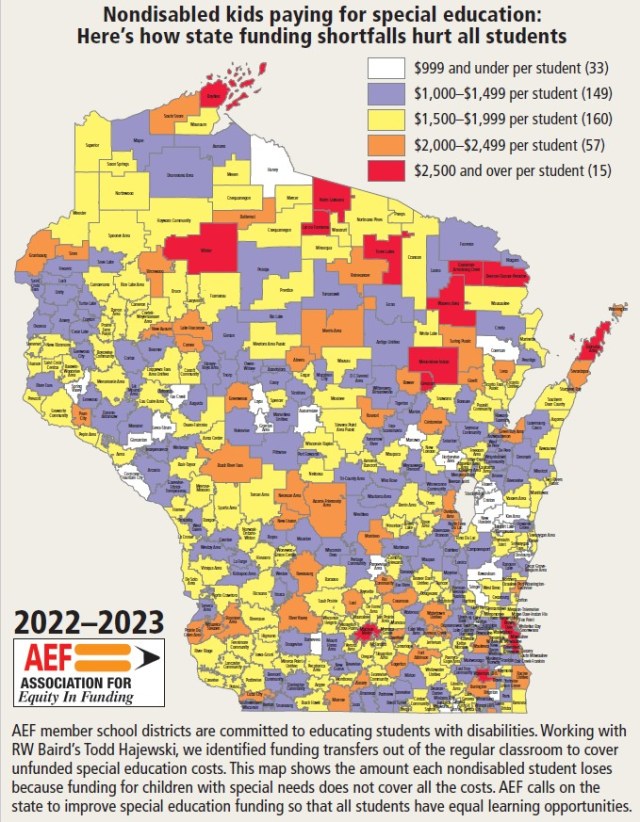
Download a high-resolution version of the 2022-2023 special education funds transfer map here.

Download a high-resolution version of the 2023-2024 special education funds transfer map here.

Wisconsin has a long history of supporting the education of children with disabilities. In fact, our special education laws predate the federal law. As far back as 1939, the legislature allowed for the education of students with special needs. In 1967, Attorney General Bronson La Follette opined that all “handicapped children had the right to a free public education.” In 1973, upon the passage of the law creating, there were concerns about funding, as the bill was trimmed to reduce the state’s cost. It was signed by Governor Lucey on August 1, 1973.

It was recently reported that “When the Individuals with Disabilities Education Act was passed in 1975, it authorized federal funding for up to 40 percent of what it costs to provide special education services for students with disabilities. But the federal government has never come close to funding at that level, hovering closer to 15 percent.” One of President Ford’s biggest concerns upon signing the federal special education bill was that federal funding would not be adequate to the demands the law would place on districts. Indeed, his predictions have come true–the state and federal commitment has fallen well behind costs. AEF has worked to make it clear exactly how much funding has to be taken from other sources to cover unfunded special education costs.

Let’s start with the very important premise that AEF member school districts are fully committed to educating students with disabilities. It’s the right thing to do and school districts spend millions of dollars to hire many professional teachers, specialists, and paraprofessionals every year to make sure children with special needs make progress commensurate with their abilities. But we can use budget data to show that these costs cut into the education of other students in ways that have a significant impact. That impact is made very clear in every school district’s annual budget through a transfer from regular education into special education. Here’s how it works:

Special education costs are entirely allocated from a specific, numbered account called “Fund 27.” That account is used to pay for everything associated with special education: staff members, equipment, special bussing, etc. The account is funded with state and federal aid for the purpose of educating children with disabilities. At the end of each fiscal year on June 30th, accounting rules prohibit a negative balance in Fund 27. The fund has to be “made whole.”

In contrast, the General Fund is called “Fund 10.” It’s where state aid and local taxes are deposited and is used to pay for regular education classroom teachers, school secretaries, textbooks, buses, and utilities, but not for students with disabilities. Districts can take money from Fund 10 to cover expenses but funds cannot go in the other direction, and in fact, districts take money from Fund 10 to cover shortfalls in Fund 27 every year. In other words, after all the income is put into Fund 27 and all the special education costs are taken from it, whatever isn’t covered, whatever the negative balance amounts to, is taken from Fund 10. It’s a challenge for districts and it’s also a very obvious number to identify in school district budgets.

AEF was interested in the amount of funding taken from Fund 10, the general education fund, to cover unfunded special education costs. We asked RW Baird’s Todd Hajewski to identify the exact transfer amount from Fund 10 to Fund 27 in every school district for the last two fiscal years. But unlike some other studies, we chose to examine the impact of that transfer amount on nondisabled students. In order to identify that cost, we divided the Fund 10 to 27 transfer amount by the number of students without IEPs to document the burden of the special education mandate on the rest of the students in the school district. The maps show the amount transferred from each nondisabled student because funding for children with special needs does not cover all the costs. Specifically, the maps show the Fund 10 to Fund 27 transfer amounts divided by the number of students without special needs.

There are a couple of key points to consider in the maps. First, looking at fiscal 22-23, almost 3/4 of school districts (309 of 421) are transferring between $1000-$1999 per nondisabled student to the special education fund. Consider what an additional $1000 or more per student could do in a classroom. We also note that 15 districts were transferring more than $2500 per student. Next, look at the map covering fiscal 23-24. The number of districts transferring more than $2500 per student has more than doubled from 15 districts to 31. Special education funding from the state went up in the last state budget, but this is a strong indication that costs are going up faster than funding rates are increasing, putting an even greater pressure on schools to make ends meet.

Some people think that providing additional special education funding will go to hire more special educators. In fact, our research suggests that it’s more likely to “backfill” funding that is currently being taken to make sure Fund 27 is covered at the end of the fiscal year. Now for the politics and perception.

A recent Marquette Law School poll included questions about funding for special education. They reported, “A majority (76%) favor a major increase in funding for special education in the schools, while 23% are opposed. Majorities of all partisan groups favor increasing special-education budgets…” It appears that there is an issue on which just about everyone is in agreement: it’s time to improve funding for special education. AEF calls on the state to improve special education funding so that all students have adequate learning opportunities.
AEF Applauds Governor’s Budget Proposal and Looks Forward to More Bipartisanship to Finally Close Revenue Gaps

For Immediate Release:
John Gaier, President
Wisconsin Association for Equity in Funding
jgaier@neillsville.k12.wi.us
715-743-3323

AEF Applauds Governor’s Budget Proposal Looks Forward to More Bipartisanship to Finally Close Revenue Gaps

February 21, 2025

Clearly recognizing the need to end decades of wildly discrepant funding levels for students in different school districts across the state, Governor Evers’ proposes another strong step toward finally leveling the playing field.

For thirty years, students in a handful of districts have been funded with thousands of dollars more than their peers across the state. This year, state law allowed 19 districts to raise more than $14,157 per student while another 172 districts could raise just $11,325 per student. Why should students in districts like New Lisbon, Antigo, Chippewa Falls, and Beloit and dozens of others get thousands of dollars less for their education than their peers? The Government should not pick “winners and losers” in the budget process. All students should be treated equally in the eyes of the state.

In the last biennial budget, the Republican-controlled Joint Finance Committee initiated an increase in the minimum per pupil funding from $10,000 to $11,325. This was a major improvement, and was signed into law by Governor Evers. Because it was paired with increased state aid, property tax increases were minimal in districts that did not pass a referendum (WI Policy Forum).

Now the Governor is leading the way to improving the funding system. His budget proposal raises the revenue amount to a minimum of $12,400 per student by the end of the biennium and pairs it with another substantial increase in state aid to districts. He would also provide more funding for districts at the top, reflecting increased costs for fuel, electricity, and staffing. Evers’ proposal makes funding more equal between students, and property taxes could even decline! But, after 3 decades of unfair and uneven funding, there is more work to be done.

AEF has called for an increase in the per pupil amount to a minimum of $12,650, such that 90% of districts would be funded within 10% of each other on a per pupil basis. How does the Evers budget proposal stack up? It gets close. If enacted, 87% of districts (366 of 421) would be funded within 10% of the new minimum. However, over 44,000 students in districts including Appleton, Wausau, Mequon, and Waunakee will still receive hundreds of dollars less per student under the Evers proposal than AEF’s proposal.

It’s time for the Joint Finance Committee to step up to finally level the playing field. Let’s bring an end to 30 years of unfair, uneven funding between districts.

The Wisconsin Association for Equity in Funding (WAEF) is a group of 70 Wisconsin school districts that seeks financial equity in the state system of school financing. Members include urban, suburban and rural schools, educating about 85,000 students across Wisconsin. The two issues that brought this group together have been the wide differences in the amount school districts have been able to invest in the education of their children (Revenue Limits) and the even wider differences in the property tax burden to pay for that investment.

#

AEF Calls for Equitable School Funding

The WI Association for Equity in Funding (AEF) today called upon elected representatives to finally end an era of vastly different funding levels for school districts across the state. In an Op-Ed published today by the Milwaukee Journal-Sentinel, AEF recalled the long history of the “Revenue Limit” system. “School districts get funded on a per-pupil basis, but the amount of funding for students isn’t the same for each district. Instead, the funding per student is based on what the district spent in 1993!” Per-student funding levels have varied substantially for 3 decades.

In the 2023-2025 state budget the Legislature heard our call and made improvements. Nevertheless, one budget cycle simply didn’t erase decades of inequities. This year, while 255 “low revenue” school districts get $11,325/student, but 22 districts get between $13,000 and $14,999 per student, and 15 districts will get a whopping $15,000 or more per student. Clearly, the system is better than it was, but there is more work to be done.

The Association for Equity in Funding is calling for another increase of the same amount as was included in the 2023-2025 state budget: $1325 in additional revenues for each student in the 255 low revenue districts. Our clarion call is this: “90% within 10%” meaning that if the budget follows this model, 90% of districts will be funded within 10% of each other on a per pupil revenue basis. State aid increases will be important to mitigate the tax impact of revenue increases in the low revenue districts. The state budget continues to create winners and losers through the funding system. That’s not fair to students, not wise for our economy, and does not align with the Wisconsin Constitution which states, “The legislature shall provide by law for the establishment of district schools, which shall be as nearly uniform as practicable” (emphasis added).

The Wisconsin Association for Equity in Funding (AEF) is a group of Wisconsin school districts that seeks financial equity in the state system of school financing. The members include urban districts such as Green Bay, Chippewa Falls and St. Francis, as well as rural districts like Antigo, Cornell, New Lisbon, and North Lake.

#

AEF Statement on Mount Horeb School Shooting

Today, AEF’s Op-Ed on the financial background of the Mount Horeb school shooting was published in the Milwaukee Journal’s Ideas Lab. Nonmembers can click through to read the article for free.

“Where you live in Wisconsin shouldn’t determine your odds to survive school shootings | Opinion
Mount Horeb voters approved referendums that paid for school security improvements.”

The Mount Horeb Area School District’s financial story caught the attention of AEF. Most people don’t realize that the voters of Mount Horeb played a key role in protecting students, and that children across Wisconsin are not equally protected from harm.

For those who may not have followed the story closely, on May 1st, a student brought a weapon onto school grounds and is believed to have attempted to gain entry into the building. He was unable to do so. When the student pointed the weapon at responding officers, he was shot and killed by law enforcement.

Mt. Horeb Area School District Superintendent Dr. Steve Salerno was quoted in the May 7th Milwaukee Journal Sentinel. “Had it not been for our community stepping up to the plate to help support capital and operational referendums…this could have been a far worse tragedy.” Voters approved referendums in 2017 and 2022 that Dr. Salerno said enabled the district to install vestibules, security cameras, locked doors and a doorbell camera system. “Lives may have been saved thanks to safety features at the school.”

AEF has to ask a critical question: Since when have schools in Wisconsin needed to pass a referendum to ensure fundamental safety measures? The answer is that each year, for more than 30 years, Mount Horeb, like dozens of other districts across the state, has received thousands of dollars less per student than many other districts. This made it necessary for Mount Horeb voters to pass multiple referendums to fund their school safety goals. The decades-old “revenue limit” system used 1993 spending as a benchmark year to set funding levels. This resulted in wide discrepancies in available funding for schools that have persisted since then. Mount Horeb has been shortchanged by the funding system since the beginning. 

Financial services firm RW Baird recently collected and analyzed data to help AEF identify historical funding gaps for districts across the state. From the start of the unfair revenue limit system in 1993 to 2021, Mount Horeb was held well below the state average funding levels for other districts. According to Baird’s analysis, if Mt. Horeb’s revenues had been at the state average since 1993-94, they could have contributed an additional $46 million dollars to the education of their students. Ironically, the total amount of the 2017 and 2022 referendums was $43 million. AEF has seen this pattern over and over: Voters want a level playing field to fund priorities for their students. Where they can, they pass referendums to collect funds, allowing the district to get to the average spending of other districts. What’s particularly unfair is that the state funding system favors a lucky few districts that are allowed to raise a lot more revenue, thus spending significantly more. Local taxpayers foot the entire first-year cost before state aid payments begin to cover a portion of the costs, creating another loss for low-revenue districts. What’s so concerning for AEF is that many school districts, despite needs including critical safety infrastructure, can’t pass a referendum or won’t even consider making the attempt because of voter opposition. Thus the limited pool of state aid remains available for districts that don’t pass referendums, another loss.

A recent report from the WI Counties Association research arm, Forward Analytics, indicates that over the 30 years since revenue limits were implemented, low-revenue districts were less likely to attempt a referendum, and they were also less likely to get referenda passed. Over the entire period studied, 58% of all referendums passed. For low-revenue districts, less than half were approved. Further, 78 school districts during the revenue limit era have never even tried to use the referendum option.

Lawmakers and voters should know that the unequal system that allows some districts to be funded at significantly higher levels than others is now clearly creating safety risks for students in low revenue districts across the state.

The last biennial budget made major inroads to improving equity of our school funding system. AEF will be advocating for another state budget once again focused on improving equity in our system. If the legislature enacts the same improvements in the revenue limit system as they did in the 2023-25 biennial budget, 90% of districts will be funded within 10% of each other. After more than 30 years, now with a new understanding of how student safety is directly connected to school funding, our next state budget should have no question about priorities and focus.

Thank goodness for the generosity and foresight of the voters, School Board, and educators in Mount Horeb. It’s time for all students across Wisconsin to be as well cared for as they are in that community. 

~~~~~~~~~~~

AEF is a membership organization made up of more than 60 public school districts, including the Mount Horeb Area School District, that in total educate about 100,000 students across the state. Over our 30 year history, we have advocated for a system of school funding that provides an equal opportunity for all students, regardless of what their school district spent in the benchmark year of 1993.

AEF Releases 2025 Revenue Limit Map

AEF is pleased to release an updated map of revenue limits for all districts in Wisconsin. In January, 2022, we released the map of revenue limits for that school year, showing the unfair and unequal funding for each student.

In the 2024-2025 map, you see significant improvement. AEF appeared at every public hearing of the Joint Finance Committee this spring. We proposed a $1500 increase in the low revenue ceiling, and we got $1000. We met with key legislators and staff members. We shared research, and talked about the challenges of low revenue districts in ways that are difficult for district leaders to do. We helped create an opportunity. We were thrilled to discover that an additional $325 per pupil increase in 2024-25 applies to all districts. That was a huge win for low revenue districts.

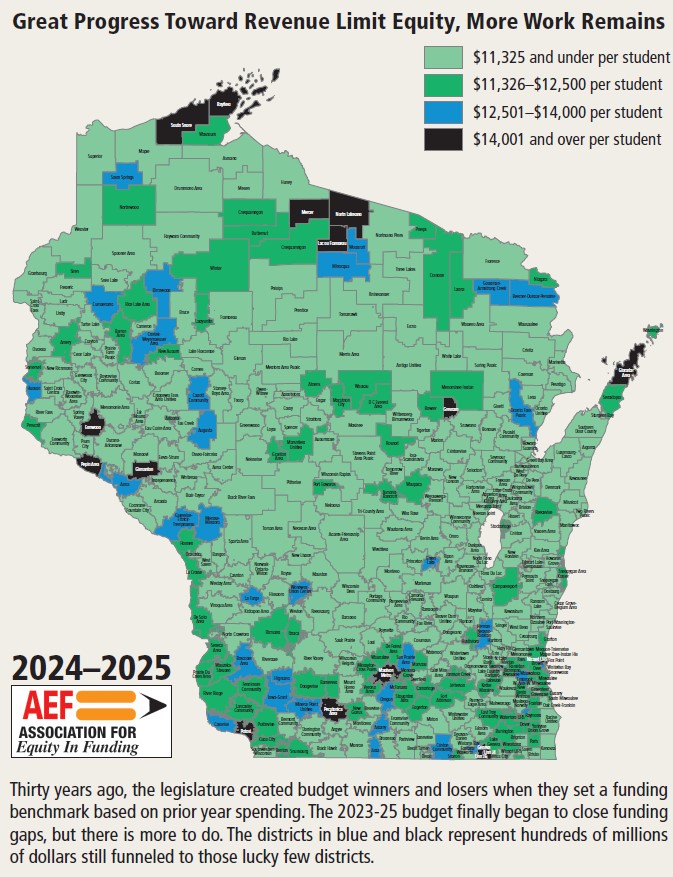
The updated map (click here for a high resolution version) shows progress by the end of the biennium: 255 districts in light green will be at the low revenue amount, and another 103 districts in dark green fall within 10% of that amount. In other words, 85% of districts (358/421) will get funding within 10% of the base. That’s a much more equitable system. But there is more work to be done. Districts in blue are getting between 10-25% more funding per pupil. Districts “in the black” are still getting $325 more per pupil in both years of the budget, pushing their revenues more than 25% over low revenue districts! Our 2025-2027 budget request will be simple: lift up from the bottom again.

As the title suggests, there is more work to be done. On Wisconsin!

WI Association for Equity in Funding Applauds Revenue Limit Progress

In 1994, the State Legislature set benchmark funding levels based on what public school districts spent in 1993. No one knew it was coming, and the inequities created then have persisted for 3 decades. AEF member districts have asked for a level playing field.

Our analysis of the proposed budget deal suggests strong progress in closing revenue limit gaps. Low revenue districts will increase their revenues from $10,000 per student to $11,000. Instead of 125 public school districts having the same revenues per student, the number increases to 261, almost two-thirds of all districts. The number of districts that are funded within 10% of the minimum will increase to 339 or 81% of the total. This is good news and we applaud the work of the Joint Finance Committee in securing this proposal.

However, there remain 160 districts with much higher revenues than others, all the way to more than $20,000 per student! Their revenues will increase by $650 per pupil. It’s frustrating to know that millions of dollars continue to flow to the lucky districts at the top. Today’s progress is good, but the education of thousands of students across the state will still be funded at substantially lower levels than others. AEF has documented serious, damaging impacts on class sizes, staffing levels, and college entrance rates in low revenue districts. This budget offered a greater opportunity to help those students realize their potential.

The Wisconsin Association for Equity in Funding (WAEF) is a group of Wisconsin school districts that seeks financial equity in the state system of school financing. Members include urban, suburban and rural schools, educating almost 100,000 students across Wisconsin.

AEF Distributes Letter to Legislators: Low Revenue Ceiling is Unconstitutional

AEF Executive Director John Humphries visited the state capitol this week, sharing a letter from AEF about the system of revenue limits, background, and making it clear that AEF believes the system is unconstitutional. We continue to expect that the legislature will make a serious effort to closing revenue limit gaps.

May 19, 2023

Dear Legislator:

AEF represents over 60 school districts educating almost 100,000 students across the state. For 30 years our per pupil revenues have been substantially lower than many districts. The current system is unconstitutional. It was never meant to be permanent. It violates the Vincent vs. Voight decision. Students in low revenue districts have larger class sizes, fewer counselors, and lower college entrance rates.

In 1848, the Wisconsin Constitution provided:

  • Article I, Section 1, that “All people are born equally free and independent, and have certain inherent rights; among these are life, liberty and the pursuit of happiness…” When some school districts get 30, 50, even 90% less funding per pupil than others, one cannot consider that “Equal Protection” under the law.
  • Article X, Section 3, that “The legislature shall provide by law for the establishment of district schools, which shall be as nearly uniform as practicable…” When some school districts get 30, 50, even 90% less funding per pupil than others, one cannot consider that “as nearly uniform as practicable.”

The 1993-95 Biennial Budget instituted revenue limits for 5 years. At the signing Governor Thompson stated, “I can assure you that we will continue to look at the equity questions this fall and come forward with a plan for the next biennial budget.” That didn’t happen and low revenue districts have mostly been stuck at the bottom of the revenue system since it was started. We have 30 years of accumulated inequity.

In 2000 The Wisconsin Supreme Court held that “Wisconsin students have a fundamental right to an equal opportunity to a sound basic education…that will equip students for their roles as citizens and enable them to succeed economically and personally.” The Court specified that districts were not “fungible” (interchangeable) and required that the extra funding needs from  “…disabled students, economically disadvantaged students, and students with limited English language skills…” be recognized.

Four years ago, the Joint Finance Committee increased the low revenue ceiling by $600 and allocated $330M in Equalization Aid. This spring, in 4 hearings around the state, I shared the critical request to increase the low revenue ceiling by $1500 per pupil and close revenue limit gaps substantially. This amount only represents inflation during the last four years. Our members are tired of living with less so that a lucky few districts can continue to spend more and more each year. Please do not add funds to all revenue limits, but focus instead on improving fairness for students in hundreds of low revenue districts.

Sincerely,

John Humphries

Executive Director

AEF Releases Revenue Limit Gaps for Legislative Districts

AEF today announced the release of 84 revenue limit gap analyses for key legislative districts. These materials will help legislators understand the impact that 30 years of revenue limits have had on their constituent school districts. In combination with our Revenue Limit Map, the new district-by-district analysis drives home the fact that Wisconsin’s system for school funding leaves almost 25% of students behind in favor of much higher funding in select school districts. As many readers know, the funding is not based on demographics or student need. Instead, revenue limits are based on what a school district was spending 3 decades ago. The differences were established then and have persisted ever since. It makes no sense and is not a fair way to distribute tax dollars.

The current legislative district analysis shows the revenue limit in every public school district for those legislators. Working with the school finance experts at RW Baird and our colleague Dr. Andrew Reschovsky, emeritus at UW-Madison’s LaFollette School of Public Affairs, we were able to show significant deficits in a single budget year as well as the cumulative effect of low funding for many school districts across the state.

We also summarized a recent research project we commissioned from Dr. Jesse Rothstein, noted economist from the University of California. In that study and a follow-up by AEF, we found significant impacts of revenue limits on district operations and student outcomes. We found that low revenue districts:

  • Send a smaller share of their students to college.
  • Spend 25% less per student on elementary teachers and have 8% more children per classroom.
  • Make up just 17% of districts that spend more than $3000 per MS/HS student, while high revenue districts are 50% of the total.
  • Spend 30% less, but have 12% more students for every school counselor.
  • Spend 22% less on nursing care compared to high revenue districts.
  • Make up just one-third of the districts spending the most on Library Media Specialists.

Furthermore, districts at the bottom level of revenues in 1993 are almost all still there today. Revenue limits trap students and districts in unfavorable funding cycles creating winners and loser every time there is a new state budget.

A brief explanatory video is available on AEF’s YouTube Channel.

In the 2019-2021 budget cycle, the Joint Finance Committee added $700 to the low revenue amount. AEF is calling for a $1500 increase in the 2023-2025 budget. This would create a situation where more than 350 out of 421 districts are funded at the same per pupil amount. In fact, over 90% of districts would be funded within 10% of the same per pupil amount. That’s a much more fair distribution of state and local tax revenues.

Here you can scroll through the data sheet for Senator Romaine Robert Quinn from a large portion of northwestern Wisconsin. See below for the links to the data sheets for all of the 84 legislators we were able to provide information to. These data sheets were distributed to the offices of these legislators at the State Capitol on March 10th, 2023 (Representative Hurd was emailed her report on 3/16/23).

AEF members agree: it’s time for the unfair, unequal, and unconstitutional revenue limit system to sunset.

For more information, contact AEF Executive Director John Humphries at (608) 438-6109 or johnhumphries.waef@gmail.com

AEF RELEASES MAPS SHOWING UNFAIR SCHOOL FUNDING AND SPECIAL EDUCATION BURDEN

The Association for Equity in Funding today released two maps that give a clear picture of the inequities in school funding and the burden experienced by nondisabled students to cover the costs of special education.

The first map shows the wide disparity in funding available to districts in the state. In blue, you see districts that get $12,000 or more to educate their students. In red, you see districts stuck at the bottom of the funding equation. These districts get $10,000 or less per student. This is unfair, illogical, and unacceptable. It’s based on a 1993 funding plan that was intended to be temporary. The legislature’s 2022-2024 budget did nothing to address these inequities.

The second map shows the dollar amounts taken from the education of every nondisabled student to cover the costs of special education. Since districts are required by law to provide special education services, and the state covers only about 30% of the costs, districts are then required to take money from regular education to cover special education costs. This map shows how much districts are transferring into special education for each student without an IEP. In other words, since the state created an unfunded mandate, nondisabled kids are losing. Districts will continue to do the right thing—educate students with disabilities. However, we also want to provide an excellent education to all students. We should not be taking major funding from the regular education classroom to cover these extra costs. The legislature’s 2022-2024 budget did very little to address these costs.